By Gina Rosenthal
Klique is an enterprise AI control plane: the layer where IT defines how every user accesses models and GPUs, usage limits, and cost controls. SUSE AI Factory with NVIDIA provides the private infrastructure behind it. This post covers what SUSE supplies, what Klique adds, and where the two meet at the Kubernetes level.
The SUSE AI Factory with NVIDIA gives organizations a secure, private environment to run AI, while Klique by ClearML provides the operational visibility to govern it by managing access, workload allocation, and cost. Included in SUSE’s recent launch announcement, Klique delivers the control layer that turns sovereign compute into a well-managed enterprise asset.
Why isn’t sovereign infrastructure enough on its own?
Owning the hardware only keeps data inside your walls if your teams use it instead of turning to unauthorized third-party tools. Most CIOs tell us the same story: IT deploys a powerful private GPU cluster, but every request for GPU access has specific requirements requiring bespoke support, creating an avalanche of support tickets. Facing the long support queue, a developer on a deadline takes a shortcut, pasting customer data into a public model API. Just like that, your proprietary data is on an external server, and IT has no visibility or audit trail.
To stop developers from taking shortcuts, your private AI environment has to be as fast and easy as public tools (without sacrificing governance). Once the private platform is running, there are still four questions to answer:
- Will teams use it? If the governed path is slower than a public API, people take the public API. Self-service access to AI LLM models and GPUs has to be the fastest option.
- Who gets the GPUs? Shared accelerators are the most expensive line in the AI budget, and without priority queues, usage policies and quotas the first team to grab them keeps them while other projects wait.
- Can you prove where data went? Regulators and auditors in Europe now expect organizations to show how AI systems are used. That proof needs a record of every model usage, by user, model, and project, plus rules that keep sensitive work on internal models.
- Who pays for what? A CFO who approved the cluster will ask what it bought, and the answer has to break down cost and token usage by team and project to provide a clear ROI.
SUSE and NVIDIA supply the infrastructure. Klique adds the self-service access, budget, quotas, and per-team usage records that cover the four questions above. With both in place, teams run AI on the private platform every day, and IT has a usage and cost record for every user, group and project.
What is the SUSE AI Factory with NVIDIA?
The SUSE AI Factory with NVIDIA is a private AI platform that SUSE built with SUSE AI and NVIDIA AI Enterprise and introduced at SUSECON in April 2026. SUSE describes it as “purpose-built to address strict global mandates for digital sovereignty.” The stack brings together SUSE Rancher Prime, NVIDIA AI Enterprise, and NVIDIA software including NVIDIA NIM™ microservices and NVIDIA OpenShell. For a bank, insurer, hospital, or government agency, that’s just a starting point. Rules on where data can live mean the hardware, the models, and the data have to stay on infrastructure the organization controls before any AI workload can go into production.
Klique: the orchestration and governance layer of the SUSE AI Factory
Klique adds the operating layer for the people who use the platform, so engineers or an agent team request AI/LLM access or compute from a pre-approved catalog instead of filing a ticket, and IT sets the limits and policies once.
| Business question | What Klique provides |
|---|---|
| How to maximize enterprise AI adoption with the AI factory? | Klique provides self-service access to compute and AI models through a budget and pre-approved catalog inside the policies IT sets. Klique also launches NVIDIA AI Enterprise workloads, such as NIM and NVIDIA Dynamo™, as one-click deployments so that IT teams can hit the ground running. |
| Who has access to AI? | Klique’s policy and scheduling engine provides priority queues, quotas, and policies to decide which team has access to what and where, and Klique shuts down instances that sit idle so capacity goes back to the pool. |
| Is organizational data protected and controlled? | Every model usage goes through the Klique LLM Gateway, which checks access rules, applies routing rules, and logs tokens by user and model. A rule can limit a sensitive project to models hosted on the platform. |
| How are costs and tokenomics managed? | Central visibility into workload orchestration, token usage, and cost per user, group, and project, which gives finance a chargeback view and builds a clear ROI on AI spend. |
How do Klique and SUSE meet at the Kubernetes level?
Klique runs on Rancher distributions including RKE2 and K3s, the same ground SUSE AI Factory stands on, so there’s no second platform for IT to operate. That matters once one estate serves many groups. Each Klique tenant gets its own secure namespace and its own Klique on-demand resources. When a group needs harder separation than a namespace gives, Klique can hand it a virtual Kubernetes cluster using SUSE K3k, an open source SUSE project that runs a virtual cluster inside an existing one. A business unit with strict isolation requirements gets its own dedicated fully isolated cluster without the organization buying and operating a second physical one.
The agent layer fits the same way. OpenShell ships in the SUSE AI Factory stack to sandbox what each agent can touch on its machine, and Klique decides which agents run, under whose identity, and against which models.
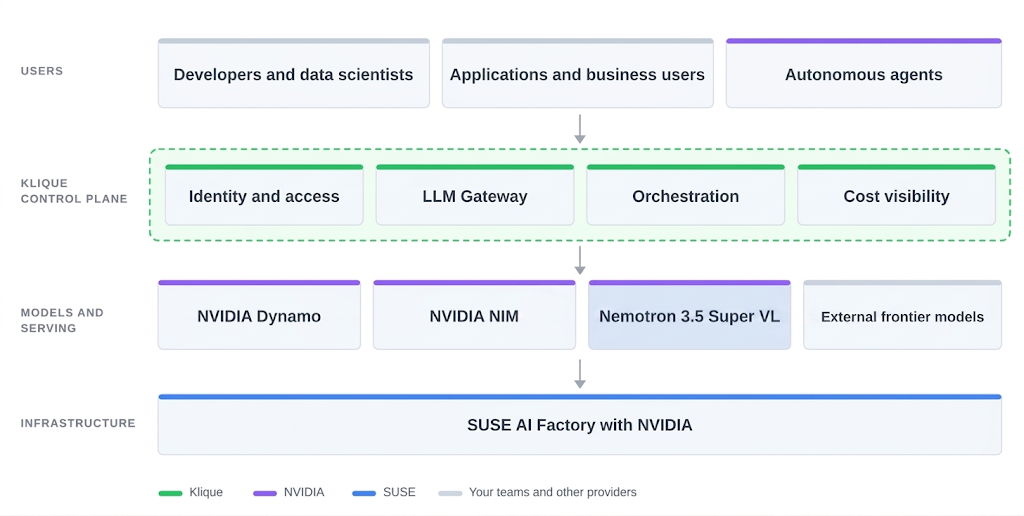
How the pieces stack up. SUSE AI Factory with NVIDIA provides the infrastructure, NVIDIA provides the models, serving, routing, and agent sandbox, and Klique governs who uses all of it and what it costs.
What IT leaders get from SUSE AI Factory with Klique
Together, SUSE AI Factory and Klique enable IT teams to easily set up and maintain an AI cluster. This gives internal stakeholders and users an easy-to-use, cloud-like web interface with agentic and API access to build on. The platform ensures all business, cost, and access requirements are met while still adhering to sovereign data policies.
For IT leaders, that means:
- Data that stays inside the organization, because routing rules keep sensitive projects on self-hosted models.
- Higher return on AI spend, since queues, quotas and slicing, and idle shutdown keep expensive accelerators working for the projects IT has prioritized.
- A record of every AI request, with every model call and GPU job logged by user, project, and cost.
- Room to add agents safely, with NVIDIA OpenShell sandboxing each agent and Klique controlling which agents run and what they can call.
See Klique and SUSE together at NVIDIA GTC Berlin
If you’re at NVIDIA GPU Technology Conference (GTC) Berlin, stop by the Klique booth, #7054, on October 20 - 22 to see Klique running on SUSE AI Factory with NVIDIA and talk through your own setup with our team.
On Wednesday, October 21 at 2:30, come to the SUSE booth to hear Klique Staff Engineer Damian Erangey give a 20-minute demo about this joint solution.
Can’t make it to Berlin? Request a demo and we’ll walk you through a sovereign AI setup for your environment.
FAQ
Why does SUSE AI Factory with NVIDIA need Klique? SUSE AI Factory keeps the hardware and data under your control, and Klique deploys the AI and governs how people and agents access it: self-service access, compute and AI quotas, model routing rules, and cost tracking by team.
Does Klique replace SUSE AI Factory with NVIDIA? Klique runs on top of it. SUSE and NVIDIA supply the infrastructure, the compute, and the life cycle management, while Klique supplies access control, routing rules, budget, quotas, metering, and orchestration on top of them.
Which Kubernetes distributions does Klique run on? Klique runs on Rancher distributions including RKE2 and K3s, alongside the other Kubernetes flavors it supports.
Can each team get its own cluster? Each tenant can either get their own on-demand compute sharing a single pool and increase overall utilization of the cluster, or they can get a dedicated compute resource utilizing SUSE K3k for flexible and secure multiple Kubernetes cluster access and management.
Can Klique keep AI traffic inside the organization? Yes. With the Klique LLM router, IT administrators can set routing rules that limit a group or project to only self-hosted models on the organization's own infrastructure, ensuring all AI requests sent under those rules go only to internal models.
What is sovereign AI? Sovereign AI means running models, data, and compute on infrastructure an organization controls, so it can meet data residency and regulatory requirements.