By Adam Wolf
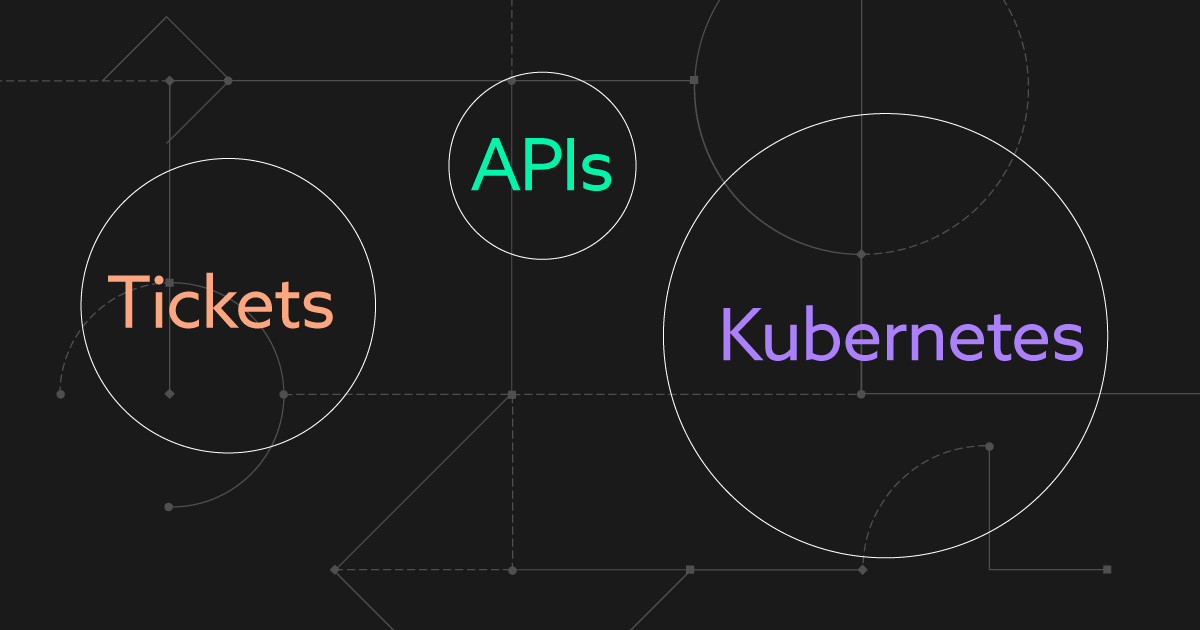
There is a gap in every enterprise running AI workloads at scale. It sits between the moment GPUs are physically present in the data center and the moment AI applications are running on them in production. The gap is not technical. It is linguistic. Three distinct communication modes (tickets for humans, APIs for agents, manifests for infrastructure) coexist inside every enterprise, and the cost of translating between them is most of what makes enterprise AI hard.
This piece names the gap, walks through what each language is good at and where it breaks, and explains why a communication fabric is the architectural answer.
The gap between procurement and production
The gap is easiest to see when something is delivered but not yet usable. A new shipment of H200s arrives at the data center. The racks are stood up. The networking is in. The power is provisioned. The GPUs are technically present.
Six weeks later, the data science team is still filing tickets asking for access to them.
This is not a hypothetical. It is the documented experience of enterprises across industries that have moved aggressively on GPU procurement without addressing the operational machinery underneath.
The same dynamic shows up in the inverse direction. A team builds an agent that needs to call an internal API. The API exists. The agent works. But the access workflow for the API requires a ticket, the ticket requires a human approver, and the human approver does not work on weekends. The agent runs on Monday morning instead of Friday afternoon, and the business outcome it was supposed to deliver is two and a half days late.
The cost of these translations adds up.
NVIDIA’s own framing of the problem, in its writeup of self-service GPU clouds, is that “today’s developers and data scientists require seamless self-service and on-demand access to compute resources” and that “traditional ticket-based systems introduce hours or even days of delay into their development cycles.”
The aggregate effect is what the industry has started calling silent spend: capacity reserved, billed, and underutilized while the people who would otherwise use it are waiting in queues that have nothing to do with the capacity itself.
Klique’s view is that this gap is not a process problem to be optimized through better tickets, faster approvals, or more automation inside any one of these systems. It is a structural problem caused by three communication modes that evolved separately and never developed a shared vocabulary. Naming the three is the first step toward closing the gap.
Three languages, three worldviews
Enterprise IT has, over the past two decades, developed three distinct communication languages for resource access. Each is fluent in a specific direction. None of them translates cleanly to the others.
Language one: tickets.
The native language of humans talking to IT. Codified in ITSM systems (ServiceNow, Jira Service Management, Freshservice) and shaped by decades of ITIL practice. Tickets are excellent at governance, approval, audit, and traceability. They are the surface where compliance lives, where change windows are negotiated, and where the ownership of “who approved what” actually gets settled. They are also, by published industry data, slow. A clean ServiceNow deployment takes three to six months. A single ticket can sit in a queue for hours or days. AI-assisted ticket deflection in modern ITSM is real (30 to 40% in the better tools) but that is deflection, not acceleration. The 60% that remain still move at human speed.
Language two: APIs.
The native language of agents and applications talking to infrastructure. REST endpoints, gRPC services, OAuth flows, JSON payloads. APIs are excellent at speed, programmatic access, and machine-readable contracts. They are how agents discover tools, how applications request inference, how schedulers fan workloads out across clusters. They are also, in most enterprises, governed by a different team and a different policy regime than the ticket system. The API gateway and the ITSM workflow rarely share an identity model, a policy engine, or a budget. When an agent calls an API, the trail goes through one set of audit logs. When a human requests the same resource through a ticket, the trail goes through a different one.
Reconstructing what actually happened across both is a cross-system investigation, not a query.
Language three: manifests.
The native language of infrastructure talking to itself. Kubernetes YAML, Terraform HCL, Helm charts, GitOps repositories. Manifests are declarative, reproducible, version-controlled, and excellent at expressing the desired state of a system in a way that the system can converge on. They have produced the productivity gains that Gartner attributes to the platform engineering movement, which is forecast to be present in 80% of software engineering organizations by 2026 and is documented to deliver 40 to 50% developer productivity improvements in mature deployments. They are also, for most knowledge workers, an opaque artifact in a language they do not speak. The data scientist who needs a GPU does not write Kubernetes YAML. The finance analyst who built an expense reconciliation agent on her laptop does not commit to a GitOps repository. The translation from human intent to manifest is the bottleneck that the ticket system was supposed to fill, and the cycle starts over.
Each of these languages is rational on its own. Each is the right tool for the audience it serves. The cost is not in any one of them. The friction is in the seams.
The cost of translation is most of what makes enterprise AI hard
Consider the typical journey of a single AI workload in an enterprise that has not addressed the three-language problem.
A data scientist needs a GPU to train a model. She submits a ticket. The ticket sits in a queue while it waits for approval from her director (one workflow), the infrastructure team (a second workflow), and the security team (a third).
Once approved, the ticket is assigned to a platform engineer who translates the request into a Kubernetes manifest, applies it to the cluster, and updates the ticket with the connection details. The data scientist receives a notification, logs in, and discovers that the GPU has been provisioned with a default storage volume that does not have access to the dataset she actually needs.
She files a second ticket.
Meanwhile, an agent the same team built last quarter needs to refresh an OAuth token that has expired. The token refresh requires a human approval step that lives in the ticket system. The agent stops. A reconciliation report fails to generate.
By the time anyone notices, the agent has been offline for 14 hours.
At the infrastructure layer, the platform engineering team is shipping changes through a GitOps workflow. Their pull requests are reviewed and merged in hours, applied to the cluster in minutes, and observable in dashboards in real time. They are the fastest part of the system. They are also, from the perspective of the data scientist filing the ticket, invisible.
The three languages are each operating at their own speed. The aggregate cycle, the actual time from “I need a GPU to train a model” to “I have results from a model trained on a GPU,” is determined by the slowest seam, not by any individual language’s clock.
Industry data backs this up at the aggregate level. Companies are hoarding expensive GPUs while most of that compute sits idle, with organizations paying for roughly 20 times more GPU capacity than their workloads actually use at any given moment. Cast AI’s 2026 State of Kubernetes Optimization Report, drawn from telemetry across 23,000 enterprise clusters, places average GPU utilization at 5%. Those numbers are not primarily a procurement problem. They are a translation problem. The GPUs are there. The seams between the languages that govern access to them are not closing fast enough.
Why this is not solved by another tool
The obvious response is to connect the three languages with integrations. ServiceNow has connectors to Kubernetes. Jira has GitOps webhooks. Kubernetes has API gateways. Every vendor has a story about how their platform integrates with the others.
These integrations exist. They are useful. Yet, they do not solve the problem.
The reason is that integrations preserve the three languages and translate between them on a per-message basis. The identity model still lives in three places. The policy engine still lives in three places. The audit trail still lives in three places. When something goes wrong, the investigation still has to span three systems with three different naming conventions, three different authentication schemes, and three different operational owners.
What enterprises need is a layer that does not just connect the three languages but speaks all three natively. A human request becomes a manifest that becomes an API call without the translation passing through three separate identity boundaries. An agent action carries its identity, its budget, and its policy context across the boundary into the infrastructure layer without a manual approval step. A manifest change generates an audit record that is queryable from the same place a ticket-driven change is queryable from. The three communication modes coexist, because each is the right tool for its audience, but the underlying state model is one.
This is what Klique seeks to accomplish by connecting humans, agents, and infrastructure. It is not a replacement for any of the three languages. It is the architectural commitment that the identity, policy, and lifecycle machinery underneath them is one system rather than three.
What a unified environment actually changes
In a Klique-mediated environment, the journey of the data scientist looks different in ways that are subtle individually and structural in aggregate.
She still files something that looks like a request. The request still goes through her director’s approval chain. The approval still produces an audit record. What changes is that the approval, the resource allocation, and the runtime configuration all flow through the same identity and policy substrate. Her director’s approval is not a ticket field that triggers a manual translation step; it is a policy update that the platform applies. The GPU she gets is provisioned with the storage access her identity permits, because the storage policy and the compute policy live in the same plane. When she submits a job, the platform knows what she is allowed to do, what budget she is spending, and what audit context to attach.
The agent that needed an OAuth refresh does not stop. The token lifecycle is governed by the same identity federation that governs her access, with short-lived, scoped tokens issued through automated workflows that match the agent’s permission scope. When the agent’s task touches a sensitive resource, the policy fires synchronously, not as a ticket that lands in a human queue 14 hours after the agent stopped.
The platform engineering team’s GitOps workflow keeps running at its native speed. What changes is that the manifests they ship reference the same identity, policy, and quota model that the human-facing surface uses. They are not building a parallel access control system for AI on top of the one the rest of the enterprise uses. They are extending the existing one.
The three languages are preserved. The translation cost between them is collapsed into a single architectural layer. That is the part that closes the gap between “we have GPUs” and “we have AI in production.”
What this means for IT decision makers
If you are running IT or platform engineering at an enterprise with serious AI investments, you have probably felt the friction this piece is describing without having vocabulary for it. The three-languages framing is not a product, a methodology, or a new acronym to memorize. It is a way to look at your existing operational reality and see where the actual cost is.
The diagnostic questions that follow from it are concrete. How long does it take, in your environment, to go from “a team wants a GPU” to “a team is using a GPU”? What fraction of that time is spent inside the three languages themselves, and what fraction is spent translating between them? How many distinct identity models govern who can do what across those three languages? When an audit question lands (“show me everything that happened on this GPU last month, and who authorized each step”), how many systems do you have to query to answer it? If the answer to any of those questions makes you uncomfortable, the gap is not theoretical for you. It is operational.
The architectural answer is not to deprecate tickets, APIs, or manifests. Each is the right communication mode for its audience. The architectural answer is to make sure the identity, policy, and lifecycle machinery underneath them is one system. That is what Klique’s communication fabric is structurally designed to provide.
Naming the gap
Every enterprise running AI at scale is paying the translation cost between tickets, APIs, and Kubernetes manifests. Most of them do not have a name for it, which is why they keep trying to solve it with more integrations between the three systems rather than with an architectural layer beneath them. The first useful thing to do is name the gap. The second is to recognize that it is not a tooling problem. The third is to design for one communication fabric, because that is what the structure of the problem actually requires.
The enterprises that get this right are the ones whose AI investments start producing operational outcomes faster than the procurement schedule predicted. The ones that do not are the ones whose AI capabilities ship slower than the markets they are competing in are moving, for reasons that look procedural and are actually architectural.
If you would like to discuss how Klique’s communication fabric fits into your AI infrastructure roadmap, get in touch.